Farming
Sahiwal Cow: Price, Milk Yield Per Day, Benefits & Profit Guide
13 Aug 2026

Ever wondered which Indian cow breed gives the highest milk yield without throwing a tantrum when the summer heat hits 45°C? It's the Sahiwal cow.
The Sahiwal cow is widely considered the heavy-duty champion of indigenous dairy breeds. A healthy Sahiwal cow typically gives 8 to 12 litres of milk per day, while high-yielding, well-managed cows can effortlessly produce 15 to 20 litres daily. With a rich fat content of 4.5% to 5.5% and pure A2 beta-casein protein, it’s no surprise that dairy farmers, organic milk brands, and health-conscious families are obsessed with this breed!
While exotic breeds might look impressive on paper, they often melt (figuratively, of course!) under India's blazing summer sun and require constant AC-level cooling and expensive vet visits.
Enter the Sahiwal cattle, the absolute rockstar of indigenous livestock.
At Swasya, where our heart beats for holistic living, chemical-free farmlands, and pure native living, we have a massive soft spot for these gentle red beauties. Our happy, free-roaming cows munch on organic fodder, soak up the sun, and gift us the liquid gold that goes directly into crafting our signature, aromatic Swasya Desi Ghee.
Whether you’re planning to start a high-margin dairy business, looking to buy a cow for your farm, or simply curious about where your morning A2 milk comes from, here is your ultimate guide to the iconic Sahiwal cow.
What Is a Sahiwal Cow? Origin, History and Characteristics
If you trace the Sahiwal cow origin, you’ll land in the Montgomery district (now in the Punjab region of Pakistan). Centuries ago, local pastoralists selectively bred these cows along the banks of the Ravi River, creating a livestock line that possessed both high milk yields and bulletproof heat tolerance.
Today, pure-bred Sahiwal cattle are thriving across Punjab, Haryana, Rajasthan, Uttar Pradesh, and progressive eco-farms across South India. In fact, because of their insane adaptability, countries like Australia, Kenya, and Brazil have imported Sahiwal genetics to upgrade their own tropical herds!
Fun Fact: The Sahiwal is nicknamed the "Lola" in its native region because of its loose, pendulous skin, a evolutionary superpower that helps it dissipate body heat efficiently!
Sahiwal Cow Milk Per Day: Average Production and Lactation
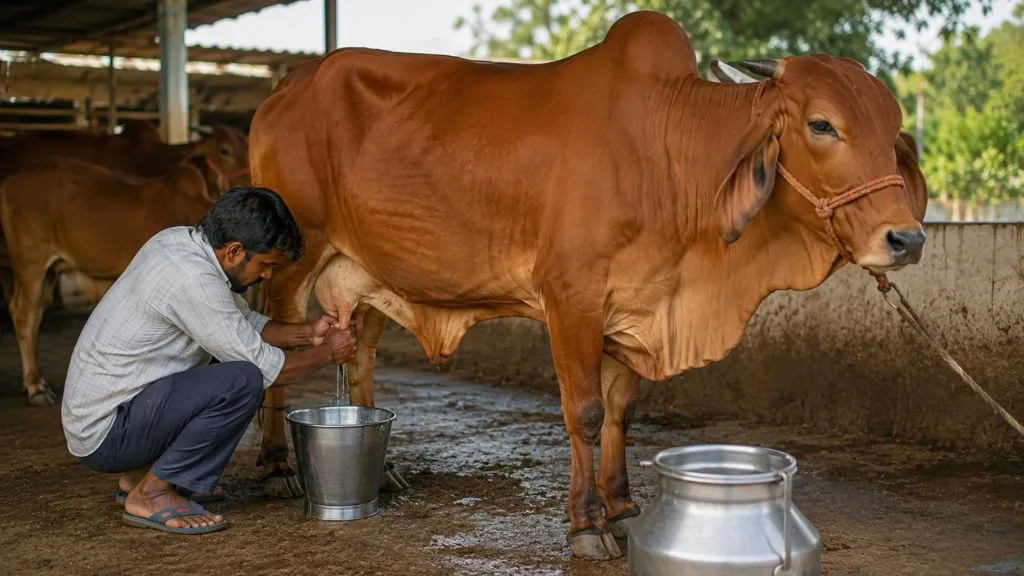
When people ask about Sahiwal cow milk per day, they are often shocked to learn that an indigenous breed can easily compete with commercial dairy strains.
Metric | Average Range | Superior Pedigree / High-Care Farms |
Daily Milk Yield | 8 – 12 Litres / day | 15 – 20 Litres / day |
Lactation Period of Sahiwal Cow | 280 – 305 Days | Up to 320 Days |
Total Lactation Yield | 2,200 – 3,000 Litres | 3,500+ Litres |
Milk Fat Percentage | 4.5% – 5.5% | Up to 6.0% |
Unlike exotic cows whose milk production plunges during peak summer, a Sahiwal keeps steady output throughout the year. That consistency is pure gold for dairy farmers!
Sahiwal Cow Milk: Fat Content, A2 Protein and Potential Benefits
Why are health-conscious households willing to pay ₹90 to ₹150 per litre for pure Sahiwal milk? It all comes down to what’s inside the bucket.
Rich A2 Beta-Casein Protein
Sahiwal milk naturally contains 100% A2 beta-casein protein, which is far easier on the human digestive tract than the A1 protein found in foreign crossbreeds. If regular milk makes you feel bloated or sluggish, A2 Sahiwal milk is often a game-changer.
Superior Fat Content for Bilona Ghee
With an average Sahiwal cow milk fat percentage ranging from 4.5% to 5.5%, this milk is thick, naturally sweet, and creamy.
High Calcium & Conjugated Linoleic Acid (CLA)
The benefits of Sahiwal cow milk go beyond digestion. It is packed with micronutrients that boost bone density, strengthen gut immunity, and promote heart health.
Also Check: Holstein Friesian Cow: Price, Milk Per Day
How to Identify a Sahiwal Cow: Key Physical Characteristics
With so many crossbreeds in the market, how do you spot a pure-bred Sahiwal cow? Keep an eye out for these distinct Sahiwal cattle characteristics:
Coat Color: Ranges from deep reddish-brown to pale red, sometimes with subtle white patches around the neck or underline.
The Dewlap: Heavy, voluminous folds of loose skin under the neck and throat (essential for heat regulation).
Horns: Short, stumpy, and thick, never long or thin.
Body Build: Symmetrical, broad torso with a prominent hump and a large, well-attached udder featuring thick, well-spaced teats.
Temperament: Exceptionally calm, gentle, and docile. They love human interaction!
Sahiwal Cow Price in India 2026: What Determines the Cost?
If you're looking to buy, the Sahiwal cow price in India varies based on lactation cycle, daily milk capacity, age, and breed purity certification.
Category | Typical Price Range (2026) | Daily Capacity Expectation |
Sahiwal Heifer (Pregnant/First-timer) | ₹40,000 – ₹60,000 | N/A (Great long-term investment) |
Active Milking Cow (2nd / 3rd Lactation) | ₹70,000 – ₹1,10,000 | 10 – 14 Litres / day |
High-Yield / Champion Pedigree | ₹1,20,000 – ₹1,60,000+ | 16 – 20+ Litres / day |
Pro-tip: While the upfront price of a pure Sahiwal is slightly higher than local breeds, the low vet bills and high milk selling price mean you recover your investment much faster.
Also Read: Different Types of Cow Breeds in India
Sahiwal vs Gir vs Red Sindhi vs Tharparkar: Which Breed Is Better?
How does the Sahiwal stack up against India's other legendary native cattle?
Feature | Sahiwal Cow | Gir Cow | Red Sindhi | Tharparkar |
Native Region | Punjab / Haryana | Gujarat (Gir Forest) | Sindh / National | Rajasthan (Thar Desert) |
Avg. Daily Milk | 8 – 12 Litres | 6 – 10 Litres | 7 – 10 Litres | 5 – 8 Litres |
Fat Percentage | 4.5% – 5.5% | 4.5% – 5.0% | 4.5% – 5.0% | 4.0% – 4.8% |
Climate Resilience | High Heat & Humidity | Hot & Dry Climates | Extremely Adaptable | Arid / Desert Conditions |
Primary Strength | Highest milk yield | Highly recognizable | Tough immunity | Survives on sparse fodder |
Is Sahiwal Dairy Farming Profitable in India?
The short answer? Yes, immensely.
When you run a commercial farm or an organic homestead with Sahiwal cows:
Premium Pricing: Plain A1 milk sells for around ₹50/litre, but certified pure Sahiwal A2 milk easily fetches ₹90 to ₹140/litre in urban markets.
Value-Added Products: Because of the high butterfat percentage, turning surplus milk into A2 Bilona Ghee (selling upwards of ₹1,800 – ₹2,500/kg) creates a massive secondary revenue stream.
Low Veterinary Overhead: Sahiwals possess natural immunity against tick-borne diseases and mastitis, keeping your medicine costs down.
Organic Farming Synergies: Sahiwal cow dung and urine are key inputs for creating Jeevamrutha and organic compost, fertilizing farmlands without a single drop of synthetic chemicals.
The Bottom Line
You don't need fancy imported crossbreeds or complex routines to get pure nutrition. Sahiwal cows bring high daily milk yield, rich A2 fat percentage, and natural heat resilience straight to the table.
FAQs
1. What is the average lactation period of a Sahiwal cow?
The standard lactation period of a Sahiwal cow is around 280 to 305 days. Peak milk production usually occurs between the 2nd and 4th month post-calving.
2. Can Sahiwal cows adapt to warm South Indian climates?
Absolutedly! Thanks to their dense sweat glands and loose dewlap, Sahiwal cattle thrive across South India (Karnataka, Tamil Nadu, Andhra Pradesh, and Telangana) just as well as in the North.
3. At what age does a Sahiwal cow deliver her first calf?
A healthy Sahiwal heifer reaches sexual maturity around 24–30 months and typically delivers her first calf between 33 and 38 months of age.
4. Is Sahiwal milk naturally A2?
Yes! Pure-bred indigenous Indian cattle breeds, including Sahiwal, Gir, and Red Sindhi, naturally produce 100% A2 protein milk.
5. What is the average lifespan of a Sahiwal cow?
With wholesome green fodder, clean water, and free-range grazing, a Sahiwal cow lives between 15 to 20 years and remains productively fertile for 10–12 lactations.
Ever wondered which Indian cow breed gives the highest milk yield without throwing a tantrum when the summer heat hits 45°C? It's the Sahiwal cow.
The Sahiwal cow is widely considered the heavy-duty champion of indigenous dairy breeds. A healthy Sahiwal cow typically gives 8 to 12 litres of milk per day, while high-yielding, well-managed cows can effortlessly produce 15 to 20 litres daily. With a rich fat content of 4.5% to 5.5% and pure A2 beta-casein protein, it’s no surprise that dairy farmers, organic milk brands, and health-conscious families are obsessed with this breed!
While exotic breeds might look impressive on paper, they often melt (figuratively, of course!) under India's blazing summer sun and require constant AC-level cooling and expensive vet visits.
Enter the Sahiwal cattle, the absolute rockstar of indigenous livestock.
At Swasya, where our heart beats for holistic living, chemical-free farmlands, and pure native living, we have a massive soft spot for these gentle red beauties. Our happy, free-roaming cows munch on organic fodder, soak up the sun, and gift us the liquid gold that goes directly into crafting our signature, aromatic Swasya Desi Ghee.
Whether you’re planning to start a high-margin dairy business, looking to buy a cow for your farm, or simply curious about where your morning A2 milk comes from, here is your ultimate guide to the iconic Sahiwal cow.
What Is a Sahiwal Cow? Origin, History and Characteristics
If you trace the Sahiwal cow origin, you’ll land in the Montgomery district (now in the Punjab region of Pakistan). Centuries ago, local pastoralists selectively bred these cows along the banks of the Ravi River, creating a livestock line that possessed both high milk yields and bulletproof heat tolerance.
Today, pure-bred Sahiwal cattle are thriving across Punjab, Haryana, Rajasthan, Uttar Pradesh, and progressive eco-farms across South India. In fact, because of their insane adaptability, countries like Australia, Kenya, and Brazil have imported Sahiwal genetics to upgrade their own tropical herds!
Fun Fact: The Sahiwal is nicknamed the "Lola" in its native region because of its loose, pendulous skin, a evolutionary superpower that helps it dissipate body heat efficiently!
Sahiwal Cow Milk Per Day: Average Production and Lactation
When people ask about Sahiwal cow milk per day, they are often shocked to learn that an indigenous breed can easily compete with commercial dairy strains.
Metric | Average Range | Superior Pedigree / High-Care Farms |
Daily Milk Yield | 8 – 12 Litres / day | 15 – 20 Litres / day |
Lactation Period of Sahiwal Cow | 280 – 305 Days | Up to 320 Days |
Total Lactation Yield | 2,200 – 3,000 Litres | 3,500+ Litres |
Milk Fat Percentage | 4.5% – 5.5% | Up to 6.0% |
Unlike exotic cows whose milk production plunges during peak summer, a Sahiwal keeps steady output throughout the year. That consistency is pure gold for dairy farmers!
Sahiwal Cow Milk: Fat Content, A2 Protein and Potential Benefits
Why are health-conscious households willing to pay ₹90 to ₹150 per litre for pure Sahiwal milk? It all comes down to what’s inside the bucket.
Rich A2 Beta-Casein Protein
Sahiwal milk naturally contains 100% A2 beta-casein protein, which is far easier on the human digestive tract than the A1 protein found in foreign crossbreeds. If regular milk makes you feel bloated or sluggish, A2 Sahiwal milk is often a game-changer.
Superior Fat Content for Bilona Ghee
With an average Sahiwal cow milk fat percentage ranging from 4.5% to 5.5%, this milk is thick, naturally sweet, and creamy.
High Calcium & Conjugated Linoleic Acid (CLA)
The benefits of Sahiwal cow milk go beyond digestion. It is packed with micronutrients that boost bone density, strengthen gut immunity, and promote heart health.
Also Check: Holstein Friesian Cow: Price, Milk Per Day
How to Identify a Sahiwal Cow: Key Physical Characteristics
With so many crossbreeds in the market, how do you spot a pure-bred Sahiwal cow? Keep an eye out for these distinct Sahiwal cattle characteristics:
Coat Color: Ranges from deep reddish-brown to pale red, sometimes with subtle white patches around the neck or underline.
The Dewlap: Heavy, voluminous folds of loose skin under the neck and throat (essential for heat regulation).
Horns: Short, stumpy, and thick, never long or thin.
Body Build: Symmetrical, broad torso with a prominent hump and a large, well-attached udder featuring thick, well-spaced teats.
Temperament: Exceptionally calm, gentle, and docile. They love human interaction!
Sahiwal Cow Price in India 2026: What Determines the Cost?
If you're looking to buy, the Sahiwal cow price in India varies based on lactation cycle, daily milk capacity, age, and breed purity certification.
Category | Typical Price Range (2026) | Daily Capacity Expectation |
Sahiwal Heifer (Pregnant/First-timer) | ₹40,000 – ₹60,000 | N/A (Great long-term investment) |
Active Milking Cow (2nd / 3rd Lactation) | ₹70,000 – ₹1,10,000 | 10 – 14 Litres / day |
High-Yield / Champion Pedigree | ₹1,20,000 – ₹1,60,000+ | 16 – 20+ Litres / day |
Pro-tip: While the upfront price of a pure Sahiwal is slightly higher than local breeds, the low vet bills and high milk selling price mean you recover your investment much faster.
Also Read: Different Types of Cow Breeds in India
Sahiwal vs Gir vs Red Sindhi vs Tharparkar: Which Breed Is Better?
How does the Sahiwal stack up against India's other legendary native cattle?
Feature | Sahiwal Cow | Gir Cow | Red Sindhi | Tharparkar |
Native Region | Punjab / Haryana | Gujarat (Gir Forest) | Sindh / National | Rajasthan (Thar Desert) |
Avg. Daily Milk | 8 – 12 Litres | 6 – 10 Litres | 7 – 10 Litres | 5 – 8 Litres |
Fat Percentage | 4.5% – 5.5% | 4.5% – 5.0% | 4.5% – 5.0% | 4.0% – 4.8% |
Climate Resilience | High Heat & Humidity | Hot & Dry Climates | Extremely Adaptable | Arid / Desert Conditions |
Primary Strength | Highest milk yield | Highly recognizable | Tough immunity | Survives on sparse fodder |
Is Sahiwal Dairy Farming Profitable in India?
The short answer? Yes, immensely.
When you run a commercial farm or an organic homestead with Sahiwal cows:
Premium Pricing: Plain A1 milk sells for around ₹50/litre, but certified pure Sahiwal A2 milk easily fetches ₹90 to ₹140/litre in urban markets.
Value-Added Products: Because of the high butterfat percentage, turning surplus milk into A2 Bilona Ghee (selling upwards of ₹1,800 – ₹2,500/kg) creates a massive secondary revenue stream.
Low Veterinary Overhead: Sahiwals possess natural immunity against tick-borne diseases and mastitis, keeping your medicine costs down.
Organic Farming Synergies: Sahiwal cow dung and urine are key inputs for creating Jeevamrutha and organic compost, fertilizing farmlands without a single drop of synthetic chemicals.
The Bottom Line
You don't need fancy imported crossbreeds or complex routines to get pure nutrition. Sahiwal cows bring high daily milk yield, rich A2 fat percentage, and natural heat resilience straight to the table.
FAQs
1. What is the average lactation period of a Sahiwal cow?
The standard lactation period of a Sahiwal cow is around 280 to 305 days. Peak milk production usually occurs between the 2nd and 4th month post-calving.
2. Can Sahiwal cows adapt to warm South Indian climates?
Absolutedly! Thanks to their dense sweat glands and loose dewlap, Sahiwal cattle thrive across South India (Karnataka, Tamil Nadu, Andhra Pradesh, and Telangana) just as well as in the North.
3. At what age does a Sahiwal cow deliver her first calf?
A healthy Sahiwal heifer reaches sexual maturity around 24–30 months and typically delivers her first calf between 33 and 38 months of age.
4. Is Sahiwal milk naturally A2?
Yes! Pure-bred indigenous Indian cattle breeds, including Sahiwal, Gir, and Red Sindhi, naturally produce 100% A2 protein milk.
5. What is the average lifespan of a Sahiwal cow?
With wholesome green fodder, clean water, and free-range grazing, a Sahiwal cow lives between 15 to 20 years and remains productively fertile for 10–12 lactations.
Akshata
You Might Also Like




Subscribe to the Swasya
newsletter
Discover insights about sustainable farming, investment opportunities, and the future of agriculture.
By subscribing, you agree to the Privacy Policy
Subscribe to the Swasya
newsletter
Discover insights about sustainable farming, investment opportunities, and the future of agriculture.
By subscribing, you agree to the Privacy Policy