Sustainability
Granite Waste in Sustainable Construction: Uses, Benefits & How Swasya Repurposes It
16 Jul 2026
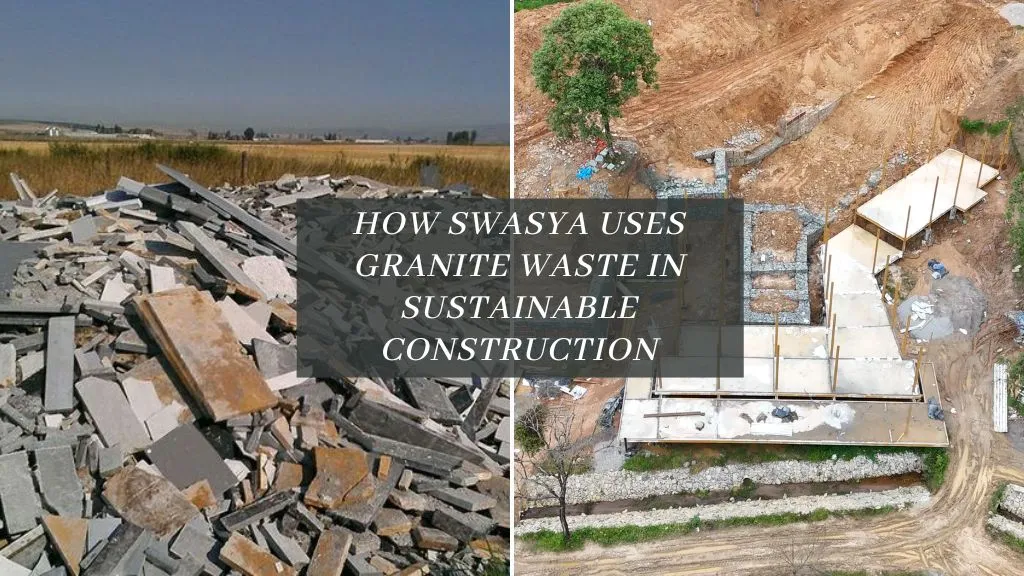
Let’s talk about something that usually gets swept under the rug. When you think about building a dream weekend home or a farmhouse, you probably think of beautiful, pristine materials. Sleek granite countertops, smooth tiles, and perfect brick walls. But have you ever stopped to think about what happens to all the broken pieces, the leftover scraps, and the thick muddy sludge left behind at the cutting factories?
Honestly, it’s a massive environmental mess. India actually holds over 20% of the entire world's granite resources. That's huge! But because of that, our local stone cutting and polishing factories generate millions of tons of waste every single year. Usually, this stuff just gets dumped illegally into landfills or open fields. It dries up into a fine powder, pollutes the air, blocks natural water streams, and ruins the soil.
At Swasya Living, we just couldn't sit back and watch that happen. We are completely obsessed with slow, sustainable living, so we decided to do something about it. If you follow our Swasya Instagram profile, you’ve probably already seen our reels showing how we take these exact broken, discarded granite pieces to breathe new life into them. We are directly reusing them across our construction projects rather than letting them choke the planet.
Let’s break down why this raw material is an absolute game-changer for the future of building, and look at the most intelligent granite waste uses that are turning literal trash into architectural strength.
Why Traditional Construction Materials Are Creating a Sustainability Problem?
Before looking at the solutions, we have to look at what we are currently replacing. To make traditional concrete blocks or even regular mortar, builders use an insane amount of natural river sand.
But river sand isn't an infinite resource. Over-extracting sand destroys river ecosystems, ruins biodiversity, and changes how water flows, which leads to severe droughts and floods. Because of this, river sand is becoming incredibly scarce and ridiculously expensive in Karnataka. We need a real, immediate alternative that doesn't compromise on structural strength.
3 Brilliant Granite Waste Uses in Modern Construction
Waste isn't actually waste until we decide to throw it away. When you process granite, you get two main types of leftovers: solid broken slabs/chips and fine sludge. Both have incredible structural benefits if you know how to process them.
1. Granite Waste in Compressed Stabilized Earth Blocks (CSEBs)
This is where the real science happens. CSEBs are eco-friendly building blocks made by compressing a mix of local soil, a tiny bit of stabilizer like cement, and fine aggregates under intense pressure.
By blending granite sludge into the mix, something amazing happens. The micro-fine granite particles act as a natural filler. They slip right into the tiny, microscopic gaps between the soil grains. The result? A much more compact, incredibly dense, and highly robust building block that handles heavy structural loads beautifully.
2. Using Granite Waste in Concrete, Foundations & Infrastructure
Those broken, odd-shaped granite pieces that countertop shops throw into the bin? They are still pure, solid granite, one of the hardest rocks on earth. At our farm sites, we crush and repurpose these solid fragments as coarse aggregates for foundation filling, retaining walls, and pathway paving. It gives the structures immense durability while cutting down our dependence on freshly quarried stone.
3. Granite Powder as a Sustainable Alternative in Mortar and Plaster
Fine granite powder can replace a significant percentage of natural fine sand in masonry mortar. It binds beautifully with cement, creating a smooth, crack-resistant plaster for walls that handles weather changes way better than cheap synthetic alternatives.
Granite Waste vs. Traditional Materials: Comparing the Environmental Impact
To give you a very clear, transparent picture of why we are pushing this movement so hard at Swasya, let’s look at how utilizing these materials completely flips the environmental script:
The Material Challenge | The Old Way (Dump & Forget) | The Swasya Repurposed Way |
Landfill Footprint | Takes up massive acreage; dries into hazardous airborne dust. | Diverted completely from landfills and locked safely into permanent walls. |
River Sand Dependency | Heavy extraction that destroys local riverbeds and boosts costs. | Dramatically reduces sand needs by using factory fine alternatives. |
Structural Density | Regular bricks can be porous, absorbing moisture during heavy monsoons. | Granite particles fill micro-voids, creating superior water resistance. |
Visual Character | Standard, uniform grey concrete walls that look industrial and cold. | Beautiful, raw, textured earthy blocks that tell an authentic green story. |
How Swasya Living Uses Granite Waste in Sustainable Construction?
For us, sustainability isn’t just a checklist we put on a brochure. It’s a core daily practice. When you visit our managed estate communities, like Sannidhi Ecofarms in Sakleshpur, you will see these granite waste uses working in real time.
We use these repurposed granite blocks and earth blends to build out our eco-clubhouses, boundary features, and estate infrastructure. They blend seamlessly into the rustic forest backdrops of our farmlands. Plus, they offer fantastic thermal insulation, keeping the indoor spaces naturally cool during hot summer days and warm during chilly monsoon nights.
It proves that you don't need to destroy the Earth to build something luxurious, safe, and beautiful.
FAQs
1. Does using granite waste make the building blocks weaker than traditional bricks?
Not at all! In fact, it's quite the opposite. Because granite is naturally a highly durable, dense rock, its fine particles act as an excellent structural filler. When compressed under high pressure into earth blocks, it fills up micro-pores, which actually enhances the overall compressive strength and long-term durability of the walls.
2. Where can people see live updates of Swasya using these sustainable materials?
We regularly document our entire on-ground construction journey, soil testing, and eco-building processes directly on our Swasya Instagram profile. You can check out our saved highlights and recent reels to see exactly how these broken stones are sorted, mixed, and turned into stable structures.
3. Is granite sludge safe to use, or does it cause health hazards inside the home?
It is completely safe once it is processed and locked into the blocks. The main health hazards of granite waste occur when dry factory powder is left floating loosely in the open air near factories, where workers can breathe it in. Once it is mixed with soil, bound tightly with stabilizers, and cured into solid blocks, it becomes entirely stable, non-toxic, and perfectly safe for residential homes.
Let’s talk about something that usually gets swept under the rug. When you think about building a dream weekend home or a farmhouse, you probably think of beautiful, pristine materials. Sleek granite countertops, smooth tiles, and perfect brick walls. But have you ever stopped to think about what happens to all the broken pieces, the leftover scraps, and the thick muddy sludge left behind at the cutting factories?
Honestly, it’s a massive environmental mess. India actually holds over 20% of the entire world's granite resources. That's huge! But because of that, our local stone cutting and polishing factories generate millions of tons of waste every single year. Usually, this stuff just gets dumped illegally into landfills or open fields. It dries up into a fine powder, pollutes the air, blocks natural water streams, and ruins the soil.
At Swasya Living, we just couldn't sit back and watch that happen. We are completely obsessed with slow, sustainable living, so we decided to do something about it. If you follow our Swasya Instagram profile, you’ve probably already seen our reels showing how we take these exact broken, discarded granite pieces to breathe new life into them. We are directly reusing them across our construction projects rather than letting them choke the planet.
Let’s break down why this raw material is an absolute game-changer for the future of building, and look at the most intelligent granite waste uses that are turning literal trash into architectural strength.
Why Traditional Construction Materials Are Creating a Sustainability Problem?
Before looking at the solutions, we have to look at what we are currently replacing. To make traditional concrete blocks or even regular mortar, builders use an insane amount of natural river sand.
But river sand isn't an infinite resource. Over-extracting sand destroys river ecosystems, ruins biodiversity, and changes how water flows, which leads to severe droughts and floods. Because of this, river sand is becoming incredibly scarce and ridiculously expensive in Karnataka. We need a real, immediate alternative that doesn't compromise on structural strength.
3 Brilliant Granite Waste Uses in Modern Construction
Waste isn't actually waste until we decide to throw it away. When you process granite, you get two main types of leftovers: solid broken slabs/chips and fine sludge. Both have incredible structural benefits if you know how to process them.
1. Granite Waste in Compressed Stabilized Earth Blocks (CSEBs)
This is where the real science happens. CSEBs are eco-friendly building blocks made by compressing a mix of local soil, a tiny bit of stabilizer like cement, and fine aggregates under intense pressure.
By blending granite sludge into the mix, something amazing happens. The micro-fine granite particles act as a natural filler. They slip right into the tiny, microscopic gaps between the soil grains. The result? A much more compact, incredibly dense, and highly robust building block that handles heavy structural loads beautifully.
2. Using Granite Waste in Concrete, Foundations & Infrastructure
Those broken, odd-shaped granite pieces that countertop shops throw into the bin? They are still pure, solid granite, one of the hardest rocks on earth. At our farm sites, we crush and repurpose these solid fragments as coarse aggregates for foundation filling, retaining walls, and pathway paving. It gives the structures immense durability while cutting down our dependence on freshly quarried stone.
3. Granite Powder as a Sustainable Alternative in Mortar and Plaster
Fine granite powder can replace a significant percentage of natural fine sand in masonry mortar. It binds beautifully with cement, creating a smooth, crack-resistant plaster for walls that handles weather changes way better than cheap synthetic alternatives.
Granite Waste vs. Traditional Materials: Comparing the Environmental Impact
To give you a very clear, transparent picture of why we are pushing this movement so hard at Swasya, let’s look at how utilizing these materials completely flips the environmental script:
The Material Challenge | The Old Way (Dump & Forget) | The Swasya Repurposed Way |
Landfill Footprint | Takes up massive acreage; dries into hazardous airborne dust. | Diverted completely from landfills and locked safely into permanent walls. |
River Sand Dependency | Heavy extraction that destroys local riverbeds and boosts costs. | Dramatically reduces sand needs by using factory fine alternatives. |
Structural Density | Regular bricks can be porous, absorbing moisture during heavy monsoons. | Granite particles fill micro-voids, creating superior water resistance. |
Visual Character | Standard, uniform grey concrete walls that look industrial and cold. | Beautiful, raw, textured earthy blocks that tell an authentic green story. |
How Swasya Living Uses Granite Waste in Sustainable Construction?
For us, sustainability isn’t just a checklist we put on a brochure. It’s a core daily practice. When you visit our managed estate communities, like Sannidhi Ecofarms in Sakleshpur, you will see these granite waste uses working in real time.
We use these repurposed granite blocks and earth blends to build out our eco-clubhouses, boundary features, and estate infrastructure. They blend seamlessly into the rustic forest backdrops of our farmlands. Plus, they offer fantastic thermal insulation, keeping the indoor spaces naturally cool during hot summer days and warm during chilly monsoon nights.
It proves that you don't need to destroy the Earth to build something luxurious, safe, and beautiful.
FAQs
1. Does using granite waste make the building blocks weaker than traditional bricks?
Not at all! In fact, it's quite the opposite. Because granite is naturally a highly durable, dense rock, its fine particles act as an excellent structural filler. When compressed under high pressure into earth blocks, it fills up micro-pores, which actually enhances the overall compressive strength and long-term durability of the walls.
2. Where can people see live updates of Swasya using these sustainable materials?
We regularly document our entire on-ground construction journey, soil testing, and eco-building processes directly on our Swasya Instagram profile. You can check out our saved highlights and recent reels to see exactly how these broken stones are sorted, mixed, and turned into stable structures.
3. Is granite sludge safe to use, or does it cause health hazards inside the home?
It is completely safe once it is processed and locked into the blocks. The main health hazards of granite waste occur when dry factory powder is left floating loosely in the open air near factories, where workers can breathe it in. Once it is mixed with soil, bound tightly with stabilizers, and cured into solid blocks, it becomes entirely stable, non-toxic, and perfectly safe for residential homes.
Akshata
You Might Also Like



Subscribe to the Swasya
newsletter
Discover insights about sustainable farming, investment opportunities, and the future of agriculture.
By subscribing, you agree to the Privacy Policy
Subscribe to the Swasya
newsletter
Discover insights about sustainable farming, investment opportunities, and the future of agriculture.
By subscribing, you agree to the Privacy Policy