Tax
Agricultural Income Tax in India : Exemption Limit, Tax Calculation
10 Jun 2026
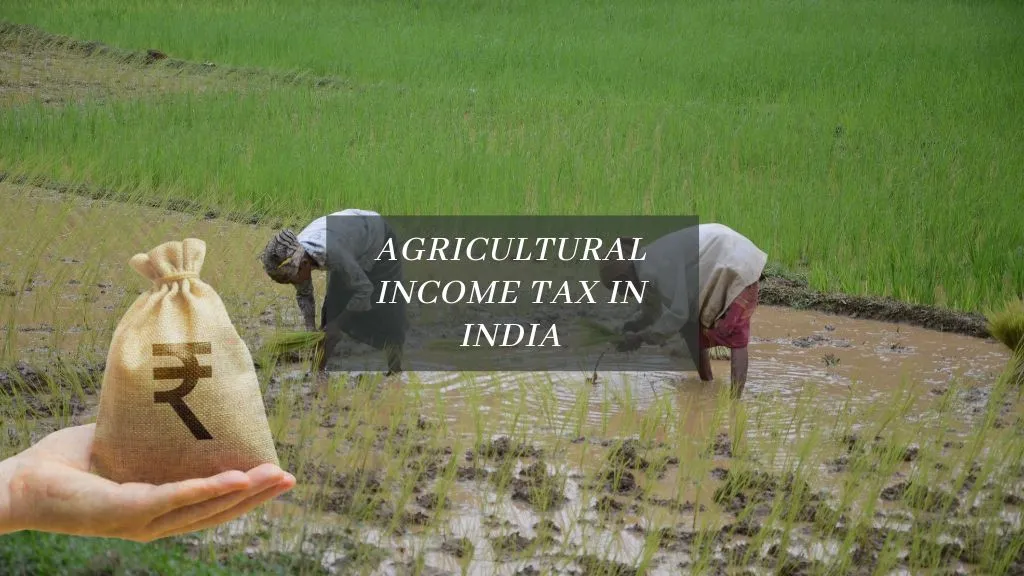
When we think about farming, we usually picture vast green fields, quiet mornings, and a deep connection to the earth. But if you are balancing a professional corporate job, running a business, or stepping into sustainable farm ownership, there is another landscape you have to navigate: the Indian tax system.
A common question that we often hear from our community members at Swasya Living is: is agricultural income fully exempted from income tax? The short answer is yes, but the long answer comes with a twist that catches many taxpayers off guard.
Let's break down everything about agriculture income in income tax, understand what is agricultural income legally, and see how the government calculates tax when you mix your regular corporate earnings with a green harvest.
What Is Agricultural Income Under the Income Tax Act?
Before claiming any tax deductions, we need to answer a foundational question: what is agricultural income under Section 2(1A) of the Income Tax Act? It doesn’t just mean selling crops in a market. Legally, it falls into three broad buckets:
Rent or Revenue: Any rent or revenue earned from agricultural land situated right here in India.
Core Farming Activities: Money generated from primary operations (tilling, sowing, planting) and subsequent operations (weeding, pruning, harvesting) to make the produce marketable.
Farm Buildings: Income from a building (like a storehouse or farmhouse) required for agricultural operations, provided it is on or immediately adjacent to the land.
Examples of Agricultural and Non-Agricultural Income
To help you visualize where the tax lines are drawn, we've broken down standard rural activities below:
Counts as Agricultural Income (Tax-Exempt) | Classified as Non-Agricultural Income (Taxable) |
Income from the sale of seeds or flower saplings | Dairy farming, poultry farming, or breeding livestock |
Income from growing creepers, bamboo, and flowers | Income from bee-hiving (apiculture) or fisheries |
Profits/Interest received by a partner from a farming firm | Cutting and selling wild timber trees without replanting |
Selling saplings or seedlings grown in a plant nursery | Income from letting out a farmhouse for TV or film shoots |
Is Agricultural Income Taxable in India?
The straightforward answer is yes, under Section 10(1) of the Income Tax Act, your annual agricultural income is completely exempt from central income tax. If your only source of income comes from tilling the soil and managing your estate, you do not owe a single rupee to the central government.
However, if you are a salaried individual, an entrepreneur, or an urban professional with a secondary stream of revenue, the taxability of agricultural income shifts into a gray zone called Partial Integration.
What Is Partial Integration of Agricultural Income?
The income tax department uses your farm earnings to indirectly bump you into a higher tax bracket for your non-farm earnings. This rule applies to individuals, Hindu Undivided Families (HUFs), AOPs, and BOIs only if:
Your net annual agricultural income exceeds ₹5,000.
Your non-agricultural income crosses the basic exemption limit of your chosen tax regime.
Note on Basic Exemption Limits (FY 2025-26 / 2026-27):
Under the default New Tax Regime, the basic exemption limit is ₹4,00,000 for all individuals. Under the Old Tax Regime, it remains ₹2,50,000 for general citizens, ₹3,00,000 for senior citizens, and ₹5,00,000 for super senior citizens.
Tax Treatment of Composite Agricultural Income
If you plan to cultivate commercial crops like tea, coffee, or rubber, the tax department views your revenue as a "composite mixture" of farming and business.
Because we manage premium estates, including organic coffee plantations in Sakleshpur, this is a rule we closely monitor for compliance:
Growing and Manufacturing Tea: 60% is treated as agricultural (exempt), 40% is non-agricultural (taxable).
Manufacturing Rubber: 65% is agricultural (exempt), 35% is non-agricultural (taxable).
Growing and Curing Coffee: 75% is agricultural (exempt), 25% is non-agricultural (taxable).
Coffee Grown, Cured, Roasted, and Grounded: 60% is agricultural (exempt), 40% is non-agricultural (taxable).
How to Calculate Tax on Agricultural Income Using Partial Integration?
Let’s look at a concrete example to demystify how agriculture income in income tax calculations actually plays out.
Suppose an individual, under the Old Tax Regime, has a regular business/salary income of ₹7,00,000 and a net annual agricultural income of ₹2,00,000.
Step 1: Calculate Tax on Aggregate Income
Add your non-agricultural income to your agricultural income to find the base rate.
₹7,00,000+ ₹2,00,000 = ₹9,00,000
Calculate the tax on this combined ₹9,00,000 under the old slab rates. This comes out to ₹92,500 (before cess).
Step 2: Calculate Tax on Agricultural Income Plus Basic Exemption Limit
Add your net agricultural income to the basic exemption limit (which is ₹2,50,000 under the old regime for individuals).
₹2,00,000 + ₹2,50,000 = ₹4,50,000
Calculate the tax on this imaginary ₹4,50,000 amount. This comes out to ₹10,000.
Step 3: Determine the Final Tax Liability
Subtract the Step 2 tax from the Step 1 tax to uncover your actual tax liability.
₹92,500 - ₹10,000 = ₹82,500
Finally, add the standard 4% Health & Education Cess on top of this final amount to complete your computation.
As you can see, your farm income remains untouched, but it successfully pushed your business income to be taxed at the higher 20% slab rate instead of the lower brackets!
Section 54B Exemption on Sale of Agricultural Land
What happens if you decide to sell an existing farm plot to buy a brand new piece of managed farmland? The capital gains tax can be a headache. Thankfully, Section 54B provides complete relief if you meet these simple criteria:
The asset sold must be agricultural land (short-term or long-term) used for farming by you or your parents for at least 2 years prior to the sale.
You must purchase another agricultural land plot within 2 years from the transfer date.
The tax exemption will be the lower of the total capital gains earned OR the amount you reinvested into the new land/Capital Gains Deposit Scheme.
Managed Farmland Ownership and Agricultural Income: From the Swasya's Perspective
Understanding the taxability of agricultural income doesn’t mean you should step away from your green dreams. At Swasya Living, we actively design our premium managed communities near Bangalore to ensure our co-owners can transition into farm life with absolute peace of mind.
When you join a managed estate like Swasya, we handle the hard manual work, from soil enrichment to transparently reporting yield distributions. It gives you a clean, documented trail of legitimate agricultural activity, making your annual ITR-2 filing straightforward and stress-free.
FAQs
1. I earned agricultural income from land situated in Nepal. Is it exempt from Indian tax?
No. The tax exemption under Section 10(1) applies exclusively to agricultural land situated within India. Any income from foreign farmland is fully taxable under the head "Income from Other Sources."
2. Which ITR form should I file for my farm income?
If your net agricultural income is up to ₹5,000, you can file using the simple ITR-1 form. However, if your farm revenue exceeds ₹5,000, you are legally required to file using the ITR-2 form.
3. Is the income from selling fruits grown from trees around my home considered agricultural?
No, it isn't. For income to be classified as agricultural, there must be systematic cultivation, tilling, and human labor deployed on actual agricultural land. Spontaneous growths or backyard gardening do not meet the criteria under the Income Tax Act.
When we think about farming, we usually picture vast green fields, quiet mornings, and a deep connection to the earth. But if you are balancing a professional corporate job, running a business, or stepping into sustainable farm ownership, there is another landscape you have to navigate: the Indian tax system.
A common question that we often hear from our community members at Swasya Living is: is agricultural income fully exempted from income tax? The short answer is yes, but the long answer comes with a twist that catches many taxpayers off guard.
Let's break down everything about agriculture income in income tax, understand what is agricultural income legally, and see how the government calculates tax when you mix your regular corporate earnings with a green harvest.
What Is Agricultural Income Under the Income Tax Act?
Before claiming any tax deductions, we need to answer a foundational question: what is agricultural income under Section 2(1A) of the Income Tax Act? It doesn’t just mean selling crops in a market. Legally, it falls into three broad buckets:
Rent or Revenue: Any rent or revenue earned from agricultural land situated right here in India.
Core Farming Activities: Money generated from primary operations (tilling, sowing, planting) and subsequent operations (weeding, pruning, harvesting) to make the produce marketable.
Farm Buildings: Income from a building (like a storehouse or farmhouse) required for agricultural operations, provided it is on or immediately adjacent to the land.
Examples of Agricultural and Non-Agricultural Income
To help you visualize where the tax lines are drawn, we've broken down standard rural activities below:
Counts as Agricultural Income (Tax-Exempt) | Classified as Non-Agricultural Income (Taxable) |
Income from the sale of seeds or flower saplings | Dairy farming, poultry farming, or breeding livestock |
Income from growing creepers, bamboo, and flowers | Income from bee-hiving (apiculture) or fisheries |
Profits/Interest received by a partner from a farming firm | Cutting and selling wild timber trees without replanting |
Selling saplings or seedlings grown in a plant nursery | Income from letting out a farmhouse for TV or film shoots |
Is Agricultural Income Taxable in India?
The straightforward answer is yes, under Section 10(1) of the Income Tax Act, your annual agricultural income is completely exempt from central income tax. If your only source of income comes from tilling the soil and managing your estate, you do not owe a single rupee to the central government.
However, if you are a salaried individual, an entrepreneur, or an urban professional with a secondary stream of revenue, the taxability of agricultural income shifts into a gray zone called Partial Integration.
What Is Partial Integration of Agricultural Income?
The income tax department uses your farm earnings to indirectly bump you into a higher tax bracket for your non-farm earnings. This rule applies to individuals, Hindu Undivided Families (HUFs), AOPs, and BOIs only if:
Your net annual agricultural income exceeds ₹5,000.
Your non-agricultural income crosses the basic exemption limit of your chosen tax regime.
Note on Basic Exemption Limits (FY 2025-26 / 2026-27):
Under the default New Tax Regime, the basic exemption limit is ₹4,00,000 for all individuals. Under the Old Tax Regime, it remains ₹2,50,000 for general citizens, ₹3,00,000 for senior citizens, and ₹5,00,000 for super senior citizens.
Tax Treatment of Composite Agricultural Income
If you plan to cultivate commercial crops like tea, coffee, or rubber, the tax department views your revenue as a "composite mixture" of farming and business.
Because we manage premium estates, including organic coffee plantations in Sakleshpur, this is a rule we closely monitor for compliance:
Growing and Manufacturing Tea: 60% is treated as agricultural (exempt), 40% is non-agricultural (taxable).
Manufacturing Rubber: 65% is agricultural (exempt), 35% is non-agricultural (taxable).
Growing and Curing Coffee: 75% is agricultural (exempt), 25% is non-agricultural (taxable).
Coffee Grown, Cured, Roasted, and Grounded: 60% is agricultural (exempt), 40% is non-agricultural (taxable).
How to Calculate Tax on Agricultural Income Using Partial Integration?
Let’s look at a concrete example to demystify how agriculture income in income tax calculations actually plays out.
Suppose an individual, under the Old Tax Regime, has a regular business/salary income of ₹7,00,000 and a net annual agricultural income of ₹2,00,000.
Step 1: Calculate Tax on Aggregate Income
Add your non-agricultural income to your agricultural income to find the base rate.
₹7,00,000+ ₹2,00,000 = ₹9,00,000
Calculate the tax on this combined ₹9,00,000 under the old slab rates. This comes out to ₹92,500 (before cess).
Step 2: Calculate Tax on Agricultural Income Plus Basic Exemption Limit
Add your net agricultural income to the basic exemption limit (which is ₹2,50,000 under the old regime for individuals).
₹2,00,000 + ₹2,50,000 = ₹4,50,000
Calculate the tax on this imaginary ₹4,50,000 amount. This comes out to ₹10,000.
Step 3: Determine the Final Tax Liability
Subtract the Step 2 tax from the Step 1 tax to uncover your actual tax liability.
₹92,500 - ₹10,000 = ₹82,500
Finally, add the standard 4% Health & Education Cess on top of this final amount to complete your computation.
As you can see, your farm income remains untouched, but it successfully pushed your business income to be taxed at the higher 20% slab rate instead of the lower brackets!
Section 54B Exemption on Sale of Agricultural Land
What happens if you decide to sell an existing farm plot to buy a brand new piece of managed farmland? The capital gains tax can be a headache. Thankfully, Section 54B provides complete relief if you meet these simple criteria:
The asset sold must be agricultural land (short-term or long-term) used for farming by you or your parents for at least 2 years prior to the sale.
You must purchase another agricultural land plot within 2 years from the transfer date.
The tax exemption will be the lower of the total capital gains earned OR the amount you reinvested into the new land/Capital Gains Deposit Scheme.
Managed Farmland Ownership and Agricultural Income: From the Swasya's Perspective
Understanding the taxability of agricultural income doesn’t mean you should step away from your green dreams. At Swasya Living, we actively design our premium managed communities near Bangalore to ensure our co-owners can transition into farm life with absolute peace of mind.
When you join a managed estate like Swasya, we handle the hard manual work, from soil enrichment to transparently reporting yield distributions. It gives you a clean, documented trail of legitimate agricultural activity, making your annual ITR-2 filing straightforward and stress-free.
FAQs
1. I earned agricultural income from land situated in Nepal. Is it exempt from Indian tax?
No. The tax exemption under Section 10(1) applies exclusively to agricultural land situated within India. Any income from foreign farmland is fully taxable under the head "Income from Other Sources."
2. Which ITR form should I file for my farm income?
If your net agricultural income is up to ₹5,000, you can file using the simple ITR-1 form. However, if your farm revenue exceeds ₹5,000, you are legally required to file using the ITR-2 form.
3. Is the income from selling fruits grown from trees around my home considered agricultural?
No, it isn't. For income to be classified as agricultural, there must be systematic cultivation, tilling, and human labor deployed on actual agricultural land. Spontaneous growths or backyard gardening do not meet the criteria under the Income Tax Act.
Akshata
You Might Also Like





Subscribe to the Swasya
newsletter
Discover insights about sustainable farming, investment opportunities, and the future of agriculture.
By subscribing, you agree to the Privacy Policy
Subscribe to the Swasya
newsletter
Discover insights about sustainable farming, investment opportunities, and the future of agriculture.
By subscribing, you agree to the Privacy Policy