Agriculture
Top 10 Agriculture Drone Companies in India in 2026
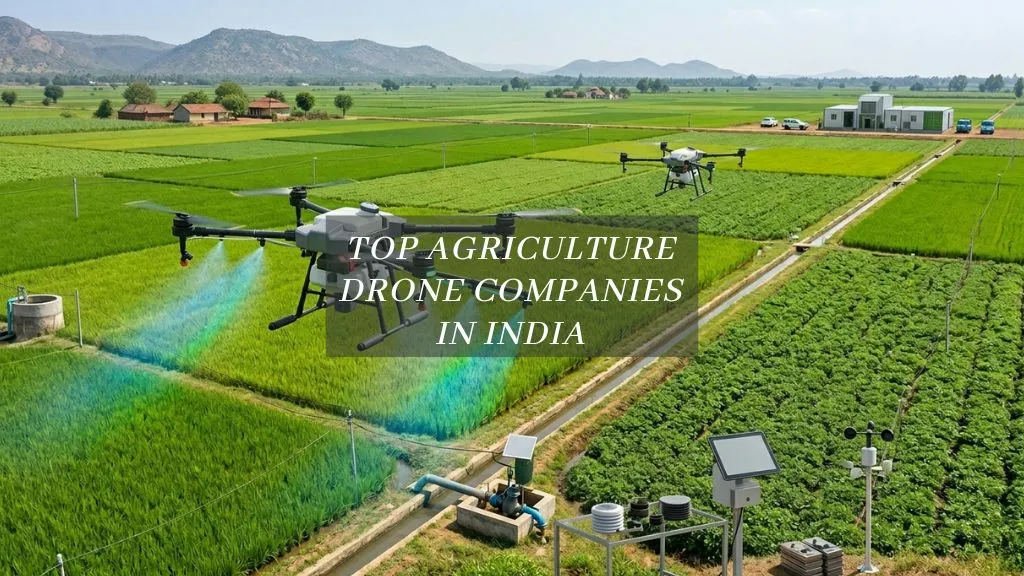
If you step out onto almost any progressive farm or managed estate in India early in the morning, you will likely hear a distinct, high-tech buzz echoing across the treeline. It isn’t the sound of traditional tractors or manual power sprayers anymore. It’s the sound of an agriculture drone navigating the sky with surgical precision.
Traditional farming in India is hitting a massive wall. Between acute rural labor shortages during peak harvesting seasons and the health hazards of manually spraying chemical pesticides under a blazing hot sun, the old ways simply aren't holding up. A single, well-engineered drone for agriculture use in india can comfortably spray an entire one-acre field in just 8 to 10 minutes, a task that takes a manual laborer over an hour of exhausting, uneven work.
Driven by government initiatives like the PLI scheme, "Drone Shakti," and subsidized financial loans, the agriculture drone india market is absolutely booming, growing at a massive 38% annually.
Whether you are an investor looking to future-proof your land, an enterprise agribusiness manager, or a grower trying to track crop stress, finding the right hardware partner is vital. Let’s bypass the marketing fluff and look at the actual top 10 drone companies in india leading the precision farming revolution in 2026, followed by what most lists completely forget to tell you.
Top 10 Agriculture Drone Companies in India (2026 Data Sheet)
To give you an honest, comprehensive birds-eye view, we have analyzed the frontrunners based on their actual on-ground deployments, flagship models, and financial backing:
Company Name & Headquarters | Flagship Model & Lift | Primary Focus & Tech USP | Financial Scale / Status |
1. IdeaForge (Mumbai) | Netra V4, Q Series (Multispectral) | High-end thermal mapping, extreme wind resistance, and rugged tactical builds. | Publicly Listed (₹314 Cr FY24 Revenue) |
2.IoTechWorld Avigation (Gurugram) | Agribot MX, Agribot A6 (10L to 16L) | Dedicated DGCA-type certified spraying systems with wide rural service networks. | High Growth (₹91.4 Cr FY24 Revenue) |
3. Garuda Aerospace (Chennai) | Kisan Drone, SURAJ (Multi-purpose) | Highly affordable, mass-market sprayers targeting small farmer clusters and FPOs. | Venture Backed (₹110.8 Cr FY24 Revenue) |
4. Paras Aerospace (Hyderabad) | Paras Agricopter V2.1 (10L Tank) | Precision targeted chemical delivery, specialized imagery sensors, and defense-grade tech. | Parent Publicly Listed (₹253.5 Cr Group Rev) |
5. Aereo (Formerly AUS) (Bengaluru) | Surveyor, Insight (Fixed-wing/Hybrid) | Advanced GIS mapping, terrain 3D modeling, and long-range farm layout compliance. | Series A Funded (₹56.1 Cr FY24 Revenue) |
6. Dhaksha Unmanned Systems (Chennai) | DH-Agrigator, DH-AG-H1 (Petrol Hybrid) | Long endurance hybrid drones backed directly by fertilizer giant Coromandel International. | Strategic Investment (₹46.4 Cr FY24 Revenue) |
7. Asteria Aerospace (Bengaluru) | A200-XT, A410-XT (AI Analytics) | Advanced cloud-linked analytics and automated crop health tracking platforms. | Reliance Backed (₹41.57 Cr FY24 Revenue) |
8. DroneAcharya Aerial Innovations | Arya, Agriveer (Multi-sensor) | Heavy emphasis on certified pilot training programs and custom remote sensing. | Publicly Listed (₹35.19 Cr FY24 Revenue) |
9. General Aeronautics (Bengaluru) | Krishak V2, GA Agribot-X5 | Flight stability matrices, integrated crop insurance data mapping, and remote diagnostics. | Agri-Tech Seeded (₹22.2 Cr Est. Revenue) |
10. IG Drones (Delhi) | Jaga Drone (5G + Edge AI) | Real-time edge AI computations paired with high-speed 5G connectivity for instant data. | Fast Scale-Up (₹22.4 Cr FY24 Revenue) |
How to Choose the Best Agriculture Drone in India?
If you talk to field operators, you'll realize that choosing the best drone for farmers isn't just about choosing the largest spray tank or the lowest price. When evaluating an agriculture drone, three technical elements matter more than anything else:
DGCA Type Certification: Never buy an uncertified drone in India. Flying a non-type-certified UAV can lead to severe regulatory penalties, and insurance companies will flatly refuse to cover any accidental damages or crashes.
Payload vs. Battery Life: A standard 10-liter payload requires a fine balance. Look for smart battery swapping systems where a single charge can consistently handle 20 to 25 minutes of active flight time under full load.
Sensor Ecosystems: Spraying is just half the battle. The best drones for agriculture feature multispectral sensors that detect early plant stress, nitrogen deficiencies, and sub-surface irrigation leaks before they become visible to the naked human eye.
Also read: Understanding Precision Farming in India
Applications of Agriculture Drones in Modern Farming
The deployment of a modern agriculture drone goes way beyond simple aerial photography. Today, top agriculture drone companies in india are delivering end-to-end software integration platforms that handle complex tasks:
Surgical Spot Spraying: Instead of drenching an entire field uniformly with chemicals, multispectral cameras identify exact pest patches. Drones apply targeted micro-doses to those spots alone, cutting your total fertilizer and pesticide costs by up to 30-40%.
Volumetric Canopy Analysis: For high-value estates cultivating timber like mahogany, or commercial orchards growing fruit, drones calculate accurate plant stand counts, height profiles, and overall canopy volume seamlessly.
Irrigation Bottleneck Mapping: Using integrated thermal imaging lenses, an operator can instantly pinpoint underground pipeline blocks, soil compaction zones, or pooling water across thousands of acres in a single afternoon flight.
The Swasya Living Edge
Here is the truth that most tech-enthusiastic land buyers learn the hard way: owning an advanced agriculture drone doesn't automatically translate to running a smart farm. Managing drone hardware is an intense, full-time commitment. You need to hire certified pilots, keep up with DGCA digital sky compliance, manage lithium-polymer battery charging cycles, and possess the agronomic knowledge needed to translate complex multispectral data maps into actual on-ground farming fixes..
At Swasya Living, we bridge this operational gap for you.
We don't expect our community co-owners to spend their valuable weekends managing farming logistics or dealing with remote property headaches. Within our premium managed communities, like Vana Vida in Kanakapura and Sannidhi Ecofarms in Sakleshpur, our dedicated, professional on-ground agricultural teams handle 100% of the heavy lifting.
From maintaining high-value timber plantations and monitoring organic coffee estate health to managing smart drip irrigation networks across the landscape, we run everything seamlessly in the background. By combining long-term land security, clean clear titles, and high-end lifestyle resort amenities with experienced, hands-on estate management, we make sure your green asset flourishes securely while you simply sit back and enjoy your peaceful countryside retreat.
FAQs
1. Is a special license mandatory to operate an agriculture drone in India?
Yes, absolutely. To operate any commercial agriculture drone india legally, the pilot must hold a valid Remote Pilot Certificate (RPC) issued by a DGCA-approved drone training school. Flying commercially without an official license is a serious violation of civil aviation rules.
2. Can a drone be used effectively on hilly terrains like coffee estates?
Yes, but you need specialized models equipped with advanced Terrain Following Radar. Drones from companies like Dhaksha or General Aeronautics feature sensors that automatically track changes in altitude, maintaining a safe, uniform distance right above the uneven canopy of hill-station plantations.
3. How much water does drone spraying save compared to manual methods?
Drones use a highly efficient technique called Ultra-Low Volume (ULV) spraying. By atomizing the liquid into ultra-fine micro-droplets, a drone can treat one acre of land using just 10 liters of water mixed with nutrients, compared to manual backpack sprayers that easily gulp down over 100 to 150 liters of water for the exact same area.
If you step out onto almost any progressive farm or managed estate in India early in the morning, you will likely hear a distinct, high-tech buzz echoing across the treeline. It isn’t the sound of traditional tractors or manual power sprayers anymore. It’s the sound of an agriculture drone navigating the sky with surgical precision.
Traditional farming in India is hitting a massive wall. Between acute rural labor shortages during peak harvesting seasons and the health hazards of manually spraying chemical pesticides under a blazing hot sun, the old ways simply aren't holding up. A single, well-engineered drone for agriculture use in india can comfortably spray an entire one-acre field in just 8 to 10 minutes, a task that takes a manual laborer over an hour of exhausting, uneven work.
Driven by government initiatives like the PLI scheme, "Drone Shakti," and subsidized financial loans, the agriculture drone india market is absolutely booming, growing at a massive 38% annually.
Whether you are an investor looking to future-proof your land, an enterprise agribusiness manager, or a grower trying to track crop stress, finding the right hardware partner is vital. Let’s bypass the marketing fluff and look at the actual top 10 drone companies in india leading the precision farming revolution in 2026, followed by what most lists completely forget to tell you.
Top 10 Agriculture Drone Companies in India (2026 Data Sheet)
To give you an honest, comprehensive birds-eye view, we have analyzed the frontrunners based on their actual on-ground deployments, flagship models, and financial backing:
Company Name & Headquarters | Flagship Model & Lift | Primary Focus & Tech USP | Financial Scale / Status |
1. IdeaForge (Mumbai) | Netra V4, Q Series (Multispectral) | High-end thermal mapping, extreme wind resistance, and rugged tactical builds. | Publicly Listed (₹314 Cr FY24 Revenue) |
2.IoTechWorld Avigation (Gurugram) | Agribot MX, Agribot A6 (10L to 16L) | Dedicated DGCA-type certified spraying systems with wide rural service networks. | High Growth (₹91.4 Cr FY24 Revenue) |
3. Garuda Aerospace (Chennai) | Kisan Drone, SURAJ (Multi-purpose) | Highly affordable, mass-market sprayers targeting small farmer clusters and FPOs. | Venture Backed (₹110.8 Cr FY24 Revenue) |
4. Paras Aerospace (Hyderabad) | Paras Agricopter V2.1 (10L Tank) | Precision targeted chemical delivery, specialized imagery sensors, and defense-grade tech. | Parent Publicly Listed (₹253.5 Cr Group Rev) |
5. Aereo (Formerly AUS) (Bengaluru) | Surveyor, Insight (Fixed-wing/Hybrid) | Advanced GIS mapping, terrain 3D modeling, and long-range farm layout compliance. | Series A Funded (₹56.1 Cr FY24 Revenue) |
6. Dhaksha Unmanned Systems (Chennai) | DH-Agrigator, DH-AG-H1 (Petrol Hybrid) | Long endurance hybrid drones backed directly by fertilizer giant Coromandel International. | Strategic Investment (₹46.4 Cr FY24 Revenue) |
7. Asteria Aerospace (Bengaluru) | A200-XT, A410-XT (AI Analytics) | Advanced cloud-linked analytics and automated crop health tracking platforms. | Reliance Backed (₹41.57 Cr FY24 Revenue) |
8. DroneAcharya Aerial Innovations | Arya, Agriveer (Multi-sensor) | Heavy emphasis on certified pilot training programs and custom remote sensing. | Publicly Listed (₹35.19 Cr FY24 Revenue) |
9. General Aeronautics (Bengaluru) | Krishak V2, GA Agribot-X5 | Flight stability matrices, integrated crop insurance data mapping, and remote diagnostics. | Agri-Tech Seeded (₹22.2 Cr Est. Revenue) |
10. IG Drones (Delhi) | Jaga Drone (5G + Edge AI) | Real-time edge AI computations paired with high-speed 5G connectivity for instant data. | Fast Scale-Up (₹22.4 Cr FY24 Revenue) |
How to Choose the Best Agriculture Drone in India?
If you talk to field operators, you'll realize that choosing the best drone for farmers isn't just about choosing the largest spray tank or the lowest price. When evaluating an agriculture drone, three technical elements matter more than anything else:
DGCA Type Certification: Never buy an uncertified drone in India. Flying a non-type-certified UAV can lead to severe regulatory penalties, and insurance companies will flatly refuse to cover any accidental damages or crashes.
Payload vs. Battery Life: A standard 10-liter payload requires a fine balance. Look for smart battery swapping systems where a single charge can consistently handle 20 to 25 minutes of active flight time under full load.
Sensor Ecosystems: Spraying is just half the battle. The best drones for agriculture feature multispectral sensors that detect early plant stress, nitrogen deficiencies, and sub-surface irrigation leaks before they become visible to the naked human eye.
Also read: Understanding Precision Farming in India
Applications of Agriculture Drones in Modern Farming
The deployment of a modern agriculture drone goes way beyond simple aerial photography. Today, top agriculture drone companies in india are delivering end-to-end software integration platforms that handle complex tasks:
Surgical Spot Spraying: Instead of drenching an entire field uniformly with chemicals, multispectral cameras identify exact pest patches. Drones apply targeted micro-doses to those spots alone, cutting your total fertilizer and pesticide costs by up to 30-40%.
Volumetric Canopy Analysis: For high-value estates cultivating timber like mahogany, or commercial orchards growing fruit, drones calculate accurate plant stand counts, height profiles, and overall canopy volume seamlessly.
Irrigation Bottleneck Mapping: Using integrated thermal imaging lenses, an operator can instantly pinpoint underground pipeline blocks, soil compaction zones, or pooling water across thousands of acres in a single afternoon flight.
The Swasya Living Edge
Here is the truth that most tech-enthusiastic land buyers learn the hard way: owning an advanced agriculture drone doesn't automatically translate to running a smart farm. Managing drone hardware is an intense, full-time commitment. You need to hire certified pilots, keep up with DGCA digital sky compliance, manage lithium-polymer battery charging cycles, and possess the agronomic knowledge needed to translate complex multispectral data maps into actual on-ground farming fixes..
At Swasya Living, we bridge this operational gap for you.
We don't expect our community co-owners to spend their valuable weekends managing farming logistics or dealing with remote property headaches. Within our premium managed communities, like Vana Vida in Kanakapura and Sannidhi Ecofarms in Sakleshpur, our dedicated, professional on-ground agricultural teams handle 100% of the heavy lifting.
From maintaining high-value timber plantations and monitoring organic coffee estate health to managing smart drip irrigation networks across the landscape, we run everything seamlessly in the background. By combining long-term land security, clean clear titles, and high-end lifestyle resort amenities with experienced, hands-on estate management, we make sure your green asset flourishes securely while you simply sit back and enjoy your peaceful countryside retreat.
FAQs
1. Is a special license mandatory to operate an agriculture drone in India?
Yes, absolutely. To operate any commercial agriculture drone india legally, the pilot must hold a valid Remote Pilot Certificate (RPC) issued by a DGCA-approved drone training school. Flying commercially without an official license is a serious violation of civil aviation rules.
2. Can a drone be used effectively on hilly terrains like coffee estates?
Yes, but you need specialized models equipped with advanced Terrain Following Radar. Drones from companies like Dhaksha or General Aeronautics feature sensors that automatically track changes in altitude, maintaining a safe, uniform distance right above the uneven canopy of hill-station plantations.
3. How much water does drone spraying save compared to manual methods?
Drones use a highly efficient technique called Ultra-Low Volume (ULV) spraying. By atomizing the liquid into ultra-fine micro-droplets, a drone can treat one acre of land using just 10 liters of water mixed with nutrients, compared to manual backpack sprayers that easily gulp down over 100 to 150 liters of water for the exact same area.
Akshata
You Might Also Like




Subscribe to the Swasya
newsletter
Discover insights about sustainable farming, investment opportunities, and the future of agriculture.
By subscribing, you agree to the Privacy Policy
Subscribe to the Swasya
newsletter
Discover insights about sustainable farming, investment opportunities, and the future of agriculture.
By subscribing, you agree to the Privacy Policy